

Ask the Mentor: How to Organize Your Desk and Office
Ask the Mentor: How to Organize Your Desk and Office

ABC Family Law & Mediation Center
Dear Mentor:
Why is my desk such a mess? There are papers and files everywhere, and it causes me so much anxiety. I clean it up to try and organize it, but it quickly becomes a mess again. I feel like I have no room to work, and I don’t know how to fix it. Help!
Signed, Failed Neatnik
Dear Neatnik:
I have to confess right off the bat that my dream job is to be a home organizer. I would jump for joy if more attorneys hired me to come in and clean up and organize their offices. (I do this as part of my attorney coaching company, New Attorney Secrets.) Yes, I love organizing, and yes, my office, desk, and home are all pretty organized. But you don’t have to be fanatical to solve this problem.
Let’s start with some rules to live by for attorneys, to minimize the stress and anxiety caused by our difficult job (and life in general):
1. Save time whenever you can; be as efficient as possible. Wasted minutes add up.
2. Make things as easy as possible to do; remove friction wherever you can. (You’re more likely to bill all your time if you have a green paper timesheet right on your desk instead of an electronic one hidden behind a bunch of open tabs on your computer.)
3. Preserve your mental health whenever you can; look for ways to create serenity in your physical environment and in your mind.
4. Accept things you cannot change. Our job is stressful. Clients are sometimes unreasonable. Things aren’t always fair. Deadlines cause anxiety. That’s the way things are. A lot of suffering comes from refusing to accept the things we cannot change.
5. When something seems impossible or overwhelming, remind yourself that you’ve had the discipline to accomplish hard things before. You passed the Bar, right? You can do other hard things, too. Start small. Little accomplishments add up.
6. Be a grownup. I don’t want to do a lot of things I have to do either, but too bad. I have to! I’m not a child anymore, and neither are you. Accept that you’re an adult and need to act like one.
How to Organize Your Desk and Office
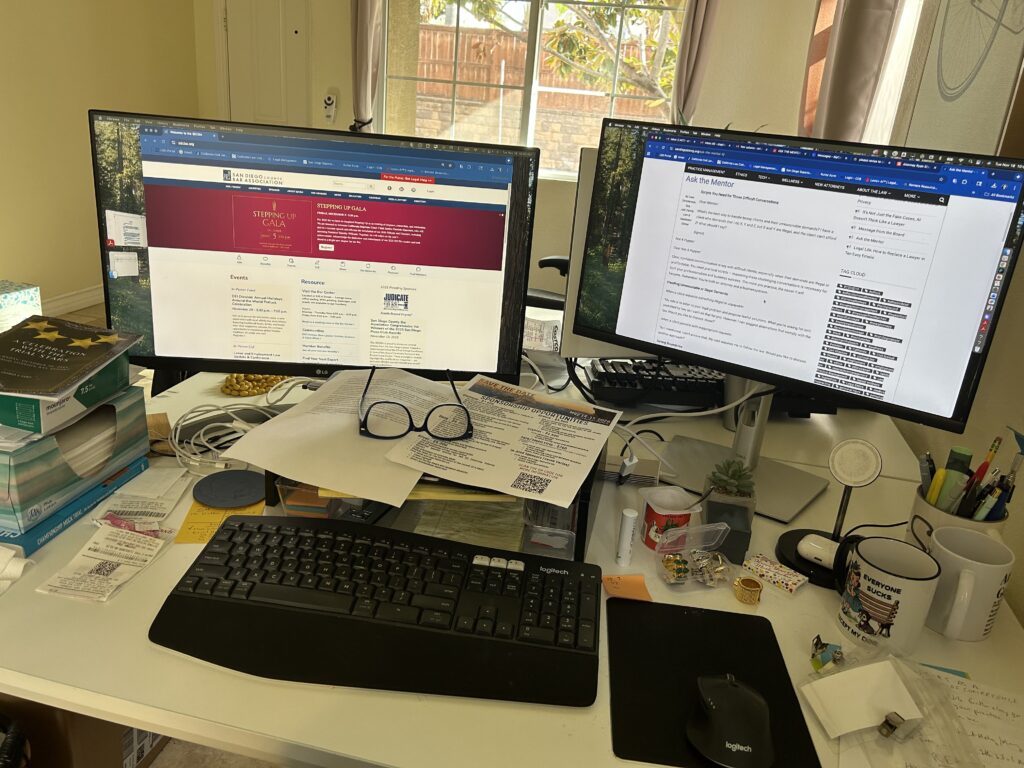
The messy desk/office is a very common problem, even for the most organized lawyers. When you have several cases going on at the same time, of course, your desk is going to be a mess. Rarely do we have the luxury of working on a single project all day long (at least I never do).
Mess and clutter cause anxiety! There is already a ton of stress and anxiety associated with practicing law, and you can’t control a lot of it. But the good news is that you CAN learn to control your physical work environment and minimize at least one thing causing you anxiety.
What kind of messes are we talking about? There are messes, and then there are messes.
Have you seen those attorney offices with hundreds of files stacked six feet high on the floor, all over the floor, on the tables, desk, credenza, and windowsill, too, with barely a walking path between the door and the desk? How do they work like that? They may claim it doesn’t bother them, but many studies have shown that a minimalist, clutter-free environment is much better for your mental health.
Make a habit of consciously taking care of your mental health, beginning when you’re young. Stress takes a toll, and the older you get, the harder it is for your body to handle. All that cortisol weakens your immune system over time. Learn ways to care for your mental health now — like adopting the tips in this column!
Optimally, you should only have out on your desk the files and documents you need for the projects you’re working on right now, plus the office equipment and supplies you need to accomplish them. You need a lot of empty space on the top of your desk so you can spread things out and think, without a lot of unnecessary distractions.
The top of your desk should not be cluttered with files, notebooks, articles, and miscellaneous paper, or office supplies like staplers, tape dispensers, hole punchers, etc. that are not needed for the projects you’re working on right now, today. Remember, you are in charge of controlling your physical environment.
I’ve helped organize a couple of really messy attorney offices and in doing so, learned many of the reasons behind the messes. Do any of these resonate with you?
You don’t put things away because:
1. You’re afraid you’ll never find them again.
2. They don’t have a designated place to live.
3. Their designated home is so full, there’s no room for anything more.
4. You don’t have time.
5. You’re so overwhelmed, you don’t know where to begin.
Let’s look at these one by one and come up with a few solutions.
1. You don’t put things away because you’re afraid you’ll never find them again.
Fair fear. The solution? Manila folders with really specific labels. Store paper documents in carefully labeled manila folders in hanging files in your desk and credenza drawers.
Never label a manila folder “Miscellaneous” or “Important Documents.” You’ll never remember what you put in there, and your fear will come true. Be specific. If you want to save a printout from a seminar, don’t name the folder “summer seminar.” Call it exactly what it is: “List of statutes of limitation from seminar” or “Bar article on organizing desk/office.”
Ask yourself what you would call a document if you were looking for it. Whatever you would call it, that’s how you should label it because that’s how your brain will think of it when you go looking for it.
Obviously, you’ll also store documents on your computer. You can rely on your document management software to help you find something if it has a robust search function (mine will search for a word in any document scanned into the system).
When you save documents on your computer, have a naming protocol and be strict about using it. Have your staff follow the same protocol. “Letter to insurance company” in a client’s online file means next to nothing, and you’ll waste time opening it to see what it is. “Letter to State Farm re: 1/25 fires (2025-1-23)” saved in the client’s online file is better. If your assistant names it “Jan 25 fire SF ltr (1-23-25)” it will be harder for you to find because you don’t name things that way. Use the same protocol. Make things easy on yourself. Save time whenever you can.
I have a manila folder labeled “Samples” in my desk drawer, so I don’t have to reinvent the wheel. I used to have a manila folder called “Critical Outlines” in my desk drawer that had printouts of the elements of causes of action I repeatedly used in complaints I was writing when I did civil litigation.
Yes, you should have a Samples file on your computer, too, but I believe in paper. With so many tabs open at a time on your computer, it’s cumbersome and annoying to switch back and forth between them. (Make things easy on yourself whenever you can.)
2. You don’t put things away because they don’t have a designated place to live.
Things need a place to live. Period. If they don’t have one, then they’re going to live on your desk and credenza and shelves and floor, etc. = clutter.
Think about this rule at home. Where do your shoes live? On the floor by the front door? On shelves in your closet? Under the table or by the TV or in the garage, i.e., wherever you kicked them off? All over the house?
If they always live on shelves in your closet, then that’s where they’ll be when you go looking for them. Save time whenever you can.
When organizing one attorney’s office, I found stacks of notebooks containing pleadings from a hearing that happened years before. All the pleadings were already saved on the computer — there was no need to keep the notebooks anymore. Why were they taking up precious real estate on top of his credenza?
Your office should be set up to help you function as efficiently as possible. Here are some tips on where things should live.
Desktop: Keep it as clutter-free as possible. Put your stapler, pens, tape, etc., in your top drawer. You need the top of your desk to spread out and work on projects. If it’s covered with files and books and random stuff, it makes work even more stressful. I’m going to keep saying it — clutter causes anxiety!
If everything has a designated home, you can put things away, leaving the top of your desk free. It’s much easier to solve the complex problems we face at work if we’re not distracted by clutter.
Drawers in desk: Use them to hold office supplies, legal pads, and business cards. In that messy attorney’s office, there were legal pads in 10 different places, including on the floor and under his desk. I found more than 20 highlighters in at least 10 different places. There were pens everywhere, plus random notebooks, seminar booklets, journals, etc. Nothing had a designated home.
Lateral drawers in desk and credenza: Use them to hold manila folders labeled really specifically, for documents you need to refer to. In the front-hanging folder, I keep green timesheets and pink telephone memo sheets to take notes. (I always take telephone call notes on these; the colored paper makes them easier to find in the file.)
Top of credenza: Your printer goes here, not on your desk. Next to that, I use a metal organizer that holds manila folders vertically and landscape-oriented, so I can easily read the labels. It’s for PENDING PROJECTS. Only folders for current projects go here. Each one is labeled with a client name (written nice and big with a Sharpie, on the tab and on the front of the folder). When I’m in the middle of the Jones project and need to turn to another one, all the papers from the Jones project go into the manila folder labeled Jones, which is held in the vertical folder holder, to make room on my desk for the new project.
I also leave some empty space on the credenza top for the inevitable stack of random papers that accumulate. I write the client’s name nice and big (“JONES”) on a 3×3 Post-It note and stick it on the upper right-hand corner of each pile of paper. I then stack them in a descending pile like cards in a solitaire game. Instant organization until I can put them away in their designated homes.
Shelf unit: Use it to hold books and accordion folders containing case files. Put a plant on a shelf, too, and something decorative like a souvenir that will remind you of a nice vacation you went on, or a photo of your darling kid.
The 10-Minute Tidy
Set your alarm for right after lunch, Monday through Friday, and plan to spend 10 minutes each day tidying up the tops of your desk and credenza.
Accept the fact that your job involves a lot of paper. You can pretend you’re paperless, but come on, you know you’re not. Lots of paper and multiple projects create mess. Like your house, you have to keep cleaning it up and cleaning it up — and then doing it again. The 10-minute tidy helps you do that.
Seminar Materials
How often do you look at those materials once the seminar is over? Never? Yeah, me neither. Then why are they cluttering up your office? Is there a library in the firm where they can be stored? Or better yet, is the book already downloaded and saved onto your computer? If so, you don’t need a paper copy in your office or in the library.
The best use of seminar materials is to pull out pages that are relevant to a case you’re working on during the seminar. Write the client’s name nice and big on the top. When you get back to the office, put the pages in the client’s file, or create a manila folder to hold it in your drawer or credenza. I like the compilations of code sections and lists of cases given out at seminars; they’re great to refer back to, so they get to live in a manila folder stored in a hanging file.
3. You don’t put things away because their designated home is so full, there’s no room for anything more.
Isn’t it nice to go to a hotel room and unpack your suitcase into all those wonderfully empty drawers? It’s so easy to put things away when there’s plenty of room. And it’s so easy to find something when the drawer isn’t stuffed so full that you can barely close it.
Your office drawers, shelves, and credenza can be the same way if you’re diligent about throwing stuff away.
It’s time to minimize! Throw it out. Shred it. Get rid of it. That’s the only way to make room for the new stuff that needs to be stored.
Eliminate redundancy. If a document is already stored on the computer and you’re not using it on the project you’re working on right now, it either gets shredded or put into a PENDING PROJECTS folder on your credenza if it’s needed for a current project. You don’t need multiple copies of things. Get rid of them!
4. You don’t put things away because you don’t have time.
As with anything we “don’t” have time for, we’re just lying to ourselves. Do you have time to scroll through Instagram for three hours on a weekday? (Go ahead, open your settings; it will tell you how long you spent on that app. Yikes.)
We all have time to do the things that are important to us because we prioritize them. I know it’s important to you to have a neat and organized desk and office, because you’ve read this far. You can make this happen if you prioritize it. Come in on a Saturday for a couple of hours and get it done. Set your alarm for the 10-minute Tidy. You can do it, and you’ll be really happy you did.
5. You don’t put things away because you’re so overwhelmed, you don’t know where to begin.
Start small with the top drawer of your desk. Take everything out. This is your most accessible drawer — so ask yourself what you need to use most days — that’s all that should go in there. Pens, highlighters, staplers, paper clips, Post-Its, small note pads, scissors, just the basics. Nothing else.
And while all that junk is out of the drawer, what can you get rid of? That name tag from the seminar you went to last summer? Out of there! Old dried up pens? Trash. Random papers? Why are they even in there? Fifteen highlighters? Put 12 back in the supply room. BE RUTHLESS. You do not need all this clutter in your drawers or in your life! Get rid of it. I guarantee it will add some serenity to your life.
Once you’ve cleaned out and organized that one drawer, open it up and see how satisfied it makes you feel. You can find things. It’s easier, less stressful. It gives you a sense of accomplishment. Use this feeling of satisfaction to motivate you to clean out the next drawer and the next.
I really hope these tips are helpful. It’s my goal in writing this column to help you make your law practice as stress-free as possible. You can do it! Need me to organize your office? Have other questions for me? Email me at Lesa@ NewAttorneySecrets.com.